Appliance Electricity Cost Calculator
Enter any device's watts and daily hours, pick your state, and get the cost per hour, day, month and year.
Any appliance cost
A17Typical wattages from energy.gov, "Estimating Appliance and Home Electronic Energy Use"; the preset is the middle of the listed range. Your label is better.
Scenario A
Sets the electricity rate. Pick US average if you're not sure.
From EIA for US average. Use the rate on your bill if you know it.
Rate used: 18.4¢/kWh · US average · EIA reference 2025–26 (data as of 2026-09-26) ·
Estimated cost per month
Per year assumes the same use every day.
Estimate. Formula and sources are under “How it works”. Change any input; the result updates as you type.
Formula
How it works
- kWh per day = watts ÷ 1,000 × hours per day
- Cost per hour = watts ÷ 1,000 × rate
- Cost per month = kWh per day × days × rate
- Cost per year = kWh per day × 365 × rate
Every "cost to run" question comes down to the same three numbers: how much power the device draws, how long it runs and what you pay per kilowatt-hour. A kilowatt-hour is 1,000 W for one hour, the unit on your bill. If a device has its own page on Home Kilowatt, the list links to it: those pages handle thermostats, seasons and efficiency ratings.
Sources: typical wattages from energy.gov, "Estimating Appliance and Home Electronic Energy Use." Electricity rate: EIA Electric Power Monthly table 5.6.A.
Worked example
A worked example
A 1,000 W appliance used 1 hour a day uses 1.00 kWh a day. At the Texas rate of 15.5¢/kWh that's $0.15 a day and $4.80 for a 31-day month.
Reference
Reference table
Cost per hour and per month at 18.4¢/kWh (US average), 1 hour a day
| per hour | per month · 1 h/day | per month · 4 h/day | |
|---|---|---|---|
| 100 W | $0.02 | $0.55 | $2.21 |
| 500 W | $0.09 | $2.76 | $11.04 |
| 1,000 W | $0.18 | $5.52 | $22.08 |
| 1,500 W | $0.28 | $8.28 | $33.12 |
| 3,000 W | $0.55 | $16.56 | $66.24 |
Questions
FAQ
How do I find the wattage of my appliance?
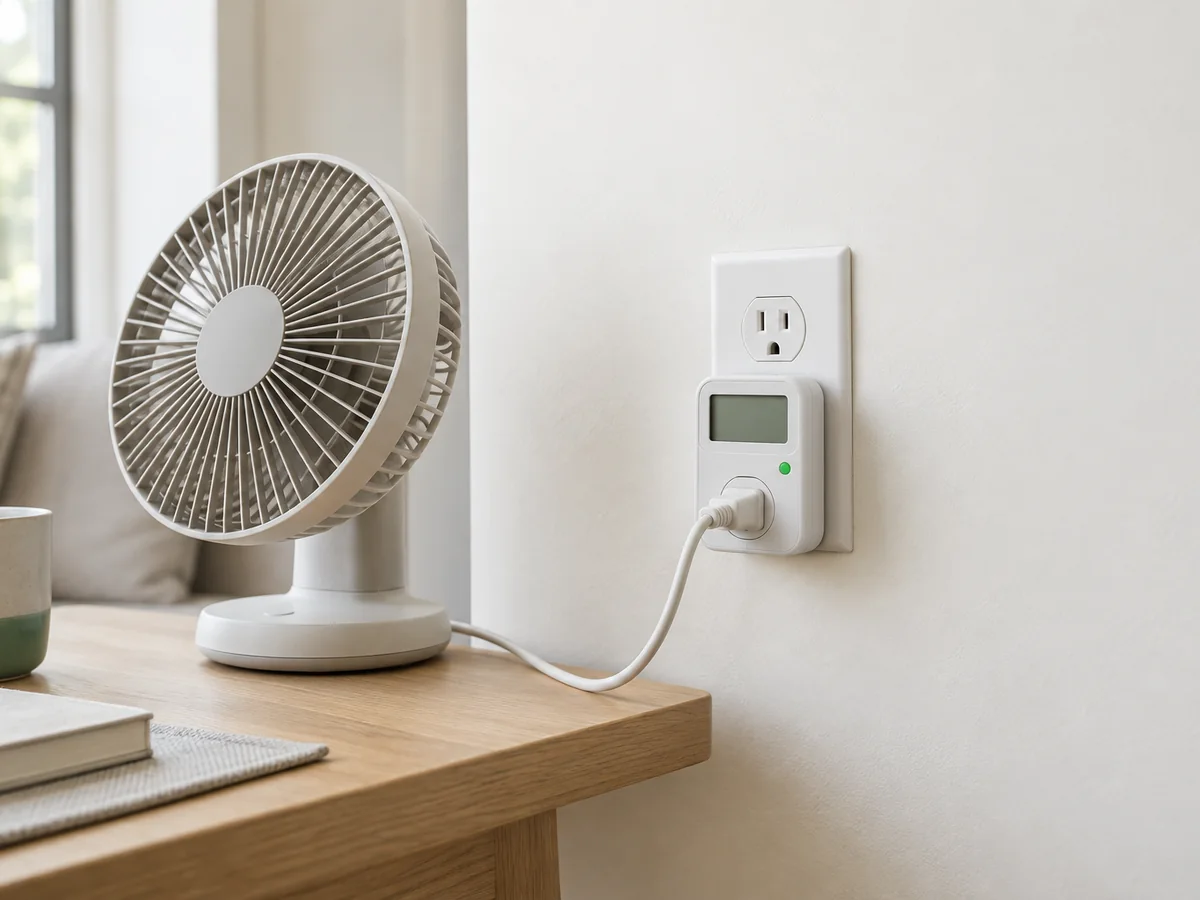
Look for the label on the back or bottom, or in the manual. If it lists only amps, multiply amps by volts (120 for a standard outlet). A plug-in power meter shows the real draw, which is often lower than the label's maximum.
What's the difference between watts, amps and kWh?
Watts measure power, the rate of use. Amps measure current: watts = volts × amps. Kilowatt-hours measure energy used over time, kWh = watts ÷ 1,000 × hours, and that's what your utility bills you for.
Which appliances use the most electricity?
In most homes, heating and cooling come first and water heating second. Pool pumps, hot tubs and electric dryers can also be large where a home has them. Use our dedicated calculators for those, then add each result to My bill to see your own ranking.
Why does my estimate differ from my bill?
The calculator covers energy charges at your state's average rate. Your bill adds fixed customer charges, taxes and sometimes tiered or time-of-use pricing. Enter the rate from your bill for a closer match.
Related